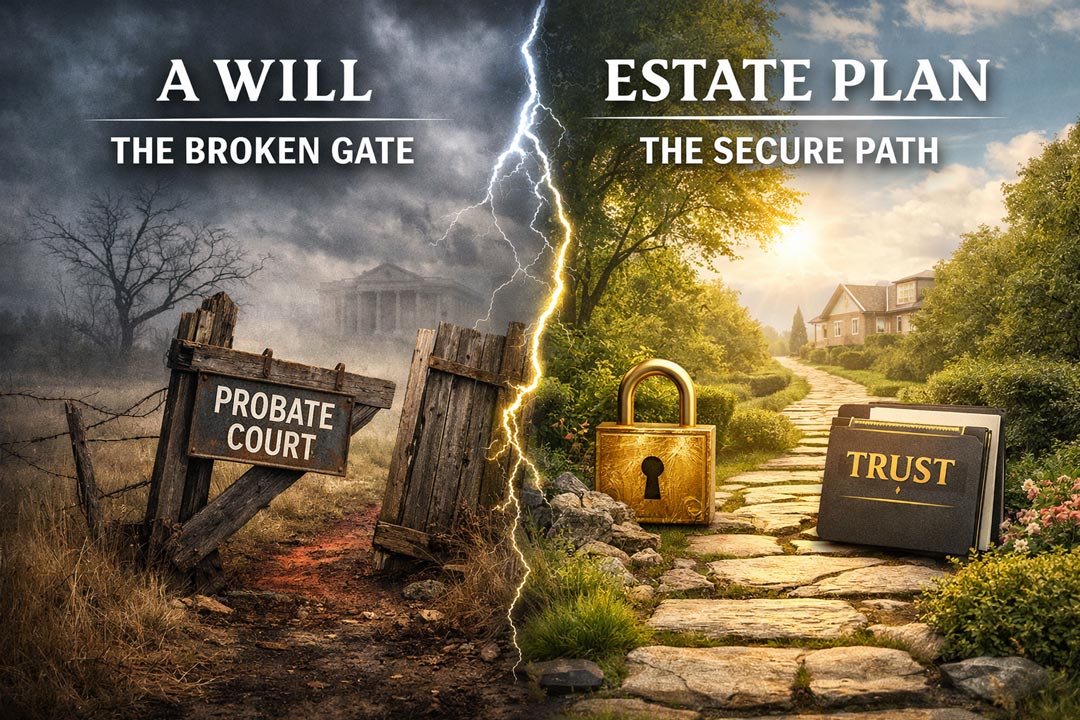
There’s a common belief in this country—one that sounds responsible on the surface, but quietly causes more damage than people realize: “I’ve got a will. I’m good.” No, you’re not. That’s not an insult. It’s a warning. Because a will, by itself, is often little more than a set of instructions that the court gets to interpret, supervise, delay, and charge your family for. And by the time most families figure that out, it’s too late.
The False Sense of Security
A will feels like planning. It feels like you’ve handled your business. But a will doesn’t avoid court—it guarantees it. That process is called probate. Probate is where your assets are frozen, your family waits (sometimes months or years), the court oversees everything, and fees and costs eat into what you built. You didn’t build your life so a system could slowly distribute it. Yet that’s exactly what a will alone sets in motion.The Story Most People Don’t See Coming
In Will’s Trusty Guide to Wills & Trusts, I tell a story about a family—real people, real consequences. A woman named Fern built a life with her husband. They saved. They worked. They did things right. When she passed, everything went to her son. That part worked. But then the son died unexpectedly without a plan. Everything went to his second wife, and his children from the first marriage received nothing. No bad intent required. No villain in the story. Just no plan.A Will Doesn’t Solve the Real Problems
A will answers one narrow question: who gets what? But estate planning is about far more than that. A real plan answers: who’s in control if you’re alive but incapacitated, how to avoid court altogether, how to protect children from bad decisions—or bad spouses, how to prevent family conflict, and how to make sure your wishes actually happen. A will doesn’t control what happens—it only starts the process.The Court Is Not Your Family
When you rely on a will alone, you’re handing authority to a system that doesn’t know your family, doesn’t care about your intent beyond legal language, moves slowly, and charges for the privilege. If you don’t make the decisions, the government will—and they don’t love your kids.The Broken Gate
Let me put it another way. A man builds a fence to protect his land. Strong posts. Good wood. Looks solid. But he leaves the gate hanging loose. Not broken enough to notice, but not secure enough to hold. One night, the cattle wander. By morning, the field is empty. The man didn’t fail because he did nothing. He failed because he thought he had done enough. A will is that loose gate. It looks like protection. It isn’t.What Real Planning Looks Like
A proper estate plan is not a document—it’s a system. It’s designed to keep your family out of court, maintain privacy, provide control during life and after death, adapt as your life changes, and actually carry out your wishes. It’s the difference between hoping things work and making sure they do. Estate planning, done right, is not a one-time event—it’s an ongoing process that evolves with your life, your family, and your assets.The Bottom Line
A will is better than nothing, but it’s not enough. And in many cases, it creates the very problems people were trying to avoid. If you love your family—truly love them—you don’t leave them with a set of instructions and a courtroom. You leave them with a plan that works.A Final Word
People don’t fail to plan because they’re careless. They fail because they’ve been told something incomplete—and believed it. Don’t let a half-solution become a full problem.