
Most people don’t set out to fail their families. They sign a will thinking they’ve done the responsible thing. They check the box. They move on with life. And unknowingly, they lay a trap. Not because a will is evil—but because a will is incomplete.
What Probate Really Is (And Why It Exists)
Let’s strip away the legal language. Probate is the government’s process for deciding who gets your assets, when they get them, and how much it costs to get there. Even if you have a will—especially if you have a will. A will doesn’t avoid probate. It guarantees it. It is simply the instruction manual the court uses while your family waits on the sidelines.
The Hidden Costs No One Talks About
Most people assume probate is just paperwork. It’s not. It’s months (sometimes years) of delay. It’s court fees and legal costs. It’s public exposure of your assets. It’s stress placed squarely on your family. And here’s the part that should bother you: your family doesn’t get to opt out. Once you’ve set that process in motion, they’re in it whether they like it or not.
The Illusion of Control
A will gives you the feeling of control. But control delayed is not control. Imagine writing instructions for your family… then handing those instructions to a stranger and saying, “You decide how this gets done.” That’s probate. That’s what a will alone creates.
When Families Break
Money doesn’t create conflict. It reveals it. And when you combine grief, delay, and uncertainty, even good families can fracture. Arguments start small—“Mom would’ve wanted this,” or “That’s not what Dad meant.” Then they grow. Because the plan wasn’t clear, wasn’t complete, or wasn’t built to handle real life. As seen time and again, people will fight harder over confusion than they ever would over clarity. 
The Parable of the Unlocked Safe
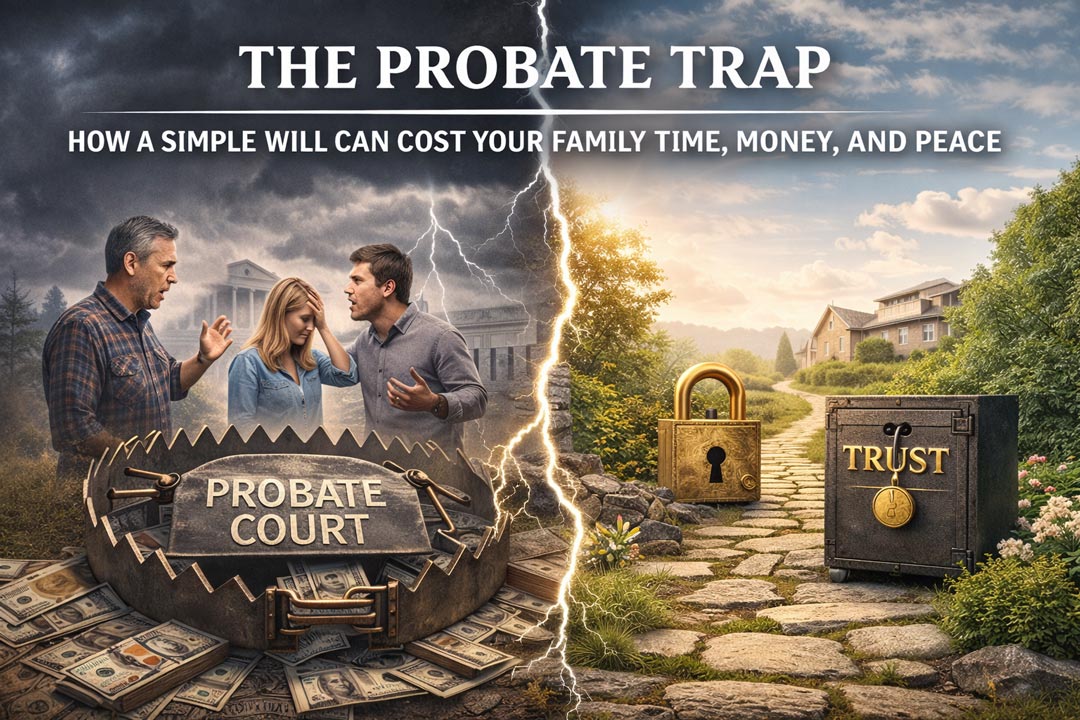
A man spent his life building wealth. He bought a heavy safe, placed everything inside, and wrote instructions for his children on how to open it. Then he left the safe sitting in the middle of town—unlocked. Anyone could touch it. Anyone could interfere. Anyone could slow things down. When his children arrived, they found the safe—but not the control. Some argued. Some waited. Some walked away. The man thought he had protected what mattered. But he had only documented it. A will is that safe. It tells the story—but it doesn’t secure the outcome.
What You Actually Want
You don’t want a document. You want speed, privacy, control, and certainty. You want your family taken care of without courtrooms, delays, or confusion. You want things handled the way you intended—not the way a process allows.
The Better Way
Real estate planning isn’t about death. It’s about control. It’s about making sure that when something happens, your family isn’t stuck waiting, your assets aren’t tied up in court, and your wishes aren’t open to interpretation. That requires more than a will. It requires a plan built to function in the real world—not just on paper.
The Bottom Line
A will is a starting point—but if that’s where your planning stops, your family will pay the price. In time. In money. In peace. And most of the time… they’ll pay in all three.