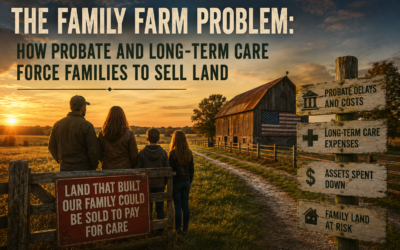
For many Missouri families, the most valuable thing they own is not the biggest bank account or the largest investment portfolio. It is the family farm, hunting property, lake cabin, or piece of land that holds decades of memories. Granddad taught the grandkids to fish there. Thanksgiving dinners were held there. Family stories were born there. Unfortunately, these treasured properties often become the source of the most painful family disputes after a loved one passes away.
Most parents assume their children will simply “work it out.” In reality, equal ownership often creates unequal expectations. One child may want to keep the property forever. Another may live out of state and have no interest in maintaining it. A third may need cash immediately and want to sell. What began as a gift intended to bring the family together can quickly become a source of resentment, conflict, and expensive legal battles.
The problem usually starts when parents leave real estate equally to multiple children without creating a plan for how the property will be managed. When three or four siblings suddenly become co-owners, every major decision requires agreement. Who pays the taxes? Who pays for repairs? Who decides when improvements are made? Who gets to use the property during deer season? These questions may seem minor today, but they can become major points of contention after Mom and Dad are gone.
Many families discover that equal ownership is not always fair ownership. One child may contribute thousands of dollars toward maintenance while another contributes nothing. One sibling may spend every weekend at the property while another never visits. Over time, frustrations grow. Eventually someone wants out, and the pressure to sell begins.
The situation becomes even more complicated when the property has been in the family for generations. The emotional value of the land often far exceeds its financial value. To one heir, selling the property feels like losing part of the family’s identity. To another, keeping it feels like an expensive burden. Neither side is necessarily wrong. They simply have different priorities.
A well-designed trust can solve many of these problems before they ever arise. Instead of transferring ownership directly to the children, the property can remain in trust under carefully written rules. The trust can specify who may use the property, how expenses are divided, how maintenance decisions are made, and what happens if a beneficiary wants to sell their interest. These rules provide clarity when emotions are running high.
In some cases, parents choose to leave the property to the child who is most likely to preserve it while balancing the inheritance with other assets distributed to the remaining children. In other situations, the trust may allow the property to remain in the family for multiple generations while providing a mechanism for resolving disputes. Every family is different, which is why a one-size-fits-all approach rarely works.
The family cabin problem is not limited to wealthy families. We see it with modest hunting properties, small farms, lake lots, and even family homes. Whenever multiple heirs inherit a piece of real estate together, there is potential for conflict if clear instructions are not already in place.
The good news is that these disputes are largely preventable. Proper estate planning allows you to decide the future of your property while you are still here to make the decisions. Instead of leaving your children a problem to solve, you can leave them a roadmap to follow.
If you own a family farm, hunting property, lake cabin, or other real estate that carries both financial and emotional value, now is the time to consider what happens after you are gone. The goal of estate planning is not simply to transfer assets. It is to preserve family harmony, protect generational wealth, and ensure that the places you love continue to tell your family’s story for years to come.
At Worsham Law Firm, we help Missouri families create trust-based estate plans designed to protect both their assets and their relationships. Because the greatest legacy you leave behind should be cherished memories—not family conflict.